
Controlled Standby/On-Call Pay,
8 Examples Used To Describe An Employee On Call
Standby or Controlled Standby are legal terms used to describe situations in which an employee is doing nothing other than waiting for their employer to call them to work, if need be. Under Federal Labor Laws and California Division of Labor Standards Enforcement Policies, time an employee spends on standby is considered work time the employee must be paid for if the time is spent primarily for the benefit of the employer. The rate of pay for standby does not have to be the employee’s regular rate of pay, but cannot be less than minimum wage.
 In order to determine if on-call, or standby time must be paid, courts look at whether:
 1. There is an on-premise living agreement
2. Whether there were excessive geographical restrictions on the employee’s movements during the period of time they were on-call.
Karl Gerber successfully handled a case in which gauge readers on oil ships docked immediately outside of the Port of Los Angeles were owed standby pay because they could not engage in every day life activities such as going to a movie, going to the supermarket, an amusement park, or a social engagement with their family because they would have to leave and thereby waste their admission fees or disturb their family during the periods of time they were on-call. Due to the traffic in the Los Angeles area they had to stay close to San Pedro at all times. For convenience they often slept in the employer’s office while they waited to be called to go into work.
3. Whether the frequency of calls is unduly restrictive. In other words, if the employer claims employees are on-call during a weekend, but in a year’s period they are not likely to be called this may not be real controlled standby. However, if the employer disciplines the employee once the employee fails to report in on a controlled standby weekend there is a legal issue about whether the employee should be paid for time spent on controlled standby.
4. Whether the on-call employee could easily trade-on-call responsibilities. This could mean a gas station worker is given the option to show up for work when somebody else fails to do so if the employee cannot find yet another employee to do so. If they find another employee to cover for them, and they are paid for the time spent making these arrangements, on-call pay for the whole period they are on-call may not be required. However, if there are consequences for not showing up if they cannot find somebody else to show up that situation could lead to a conclusion the employee is on restrict on-call.
5. Whether use of a pager (smart phone now) could ease the restrictions on having to be available. This might mean the employee has the ability to reject the assignment, or the employer begins paying them the moment the employee is called about the assignment. In a pager case, California employees were not due standby pay merely because they wore the pager. Again, the question is whether the employee is unduly restricted in what personal pursuits they can engage in while on-call.
6. Whether the employee had actually engaged in personal activities during on-call-time.Testimony from the employee they frequently went out of town while on-call is bad. Employees who went about their personal business without ever being called in while on-call presents only a theoretical on-call situation.
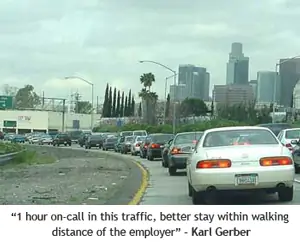
7. Strict requirements on how quickly the employee must report to work if on-call. We are presently investigating a class action in which a nurse was fired for not being able to go to a private patient’s house within one hour. One hour rules are common in on-call cases. If commutes are long or the employment takes place in a metropolitan area with a lot of traffic, one hour is not long and prevents employees from being more than 10 miles from their employer.
8. Rules about how many on-call assignments the employee can reject
The California Division of Labor Standards Enforcement summarizes controlled-standby as, simply requiring the worker to respond to call backs is not so inherently intrusive as to require a finding that the worker is under the control of the employer. Such factors as (1) geographical restrictions on employees’ movements; (2) required response time; (3) the nature of the employment; and, (4) the extent the employer’s policy would impact on personal activities during on-call time, must all be considered. The bottom-line consideration is the amount of “control” exercised by the employer over the activities of the worker. In some employments, the employer can be said to be exercising some limited control over his employee at all times.
Controlled standby cases can result in considerable wages being owed to employees. In a case where Karl Gerber represented more than eight separate employees, the average recovery per worker for unpaid on-call time was in the $35,000-$50,000 range over a several year period. In a case in which he represented two limousine drivers, the total settlement was $175,000 for time spent on-call. Thus, each driver’s on-call case settled for $87,500.
In a case involving two low voltage technicians we recovered $450,000. For two technical trouble shooters at a hospital we recovered over $300,000. For two technical employees in the broadcast business we recovered $275,000. For on-call hospice nurses we recovered about $300,000. In a class action involving a small group of disaster workers we recovered $800,000 because that employer failed to pay on-call pay. For one oil field worker we recovered $175,000 due to on-call pay.
Matters of controlled standby pay are fact intensive. The California Division of Labor Standards Enforcement states these cases are face intensive and so they cannot adopt a bright line test for when employees must be paid to be on-call. They also indicate the rules may be different for healthcare. Due to the factual complexities of on-call pay cases, you are best off letting an experienced labor lawyer ask you questions targeted to find out what your chance is to win an on-call pay case.
If you have any questions about whether you should be paid for controlled standby or any on-call employment situation call us at (818) 783-7300.
Our Firm: No Upfront Fees or Costs
Contingency Fee Representation
All employment cases for employees are taken on a contingency basis. We are only paid a fee when and if we win your case, and we advance all litigation costs. Our goal is to make expert legal representation accessible to every hardworking employee.
Serving Los Angeles County
We have proudly served all of Los Angeles County since 1993.
The Employment Lawyers Group has successfully handled
Separate California Employment Cases
Media Engagements















Sample Case Results
breach of commission contract
$1,150,000
Unpaid commissions of two plaintiffs
unpaid wages
$875,000
For 4 oil field service industry workers whose times worked were not recorded on timesheets and were on-call
forced to work without pay standby pay case
$800,000
Controlled stand by class action settlement
Disclaimer: These results are based on the facts of these specific cases and do not guarantee or predict a similar result in any future case.
Practice Areas
Discrimination
Age, Disability, FMLA/CFRA, Gender, National Origin, Pregnancy, Race, and Sexual Orientation discrimination claims.
Unpaid Wages & Overtime
Recovering earnings for overtime, bonuses, commissions, meal & rest break violations, and prevailing wage claims.
Sexual Harassment
Compassionate and effective representation for sexual harassment and hostile work environment claims.
Wrongful Termination
Representing employees terminated in violation of public policy, contracts, or California and federal law.
Leaves & Retaliation
Protecting employees who face adverse actions after reporting illegal activity or taking protected medical leave.
Whistleblowers
Advocating for employees who report fraud, waste, or abuse under California and federal whistleblower protection laws.
Our California Locations

Bakersfield
5401 Business Park S, #214,
Bakersfield CA 93309


Sacramento
777 Campus Commons Rd, #200,
Sacramento CA 95825


San Francisco / Bay Area
524 Union St, #400,
San Francisco CA 94133

San Jose / Silicon Valley
111 N. Market St, #300,
San Jose CA 95113


Torrance / South Bay
3655 Torrance Blvd, 3rd Floor,
Torrance CA 90503

Additional Sites


About Firm Founder, Karl Gerber
Firm Founder, Karl Gerber, has been an employment and wrongful termination attorney since 1993. He has represented a wide range of employees throughout California.
Mr. Gerber has won 51 of the binding arbitrations and jury trials he first chaired, and a number of his appeals are published. This deep trial experience is the foundation of the firm's strategic approach to litigation.
The employment attorneys employed by the Employment Lawyers Group have worked at the firm well in excess of five years, have also tried many different labor cases, and have all been extensively trained on employment and wrongful termination law by Karl Gerber.
Ready to Discuss Your Case?
Your rights as an employee matter. Submit a contact form and we'll get back to you.
Contact Us
Share Your Workplace Situation Directly With Our Attorneys Via This Form.